Cumberland County Court of Common Pleas Overview
The Court of Common Pleas is the general trial court for Cumberland County, which sits in Judicial District 09 of Pennsylvania's Unified Judicial System. It hears the serious work: felony and major criminal cases, major civil suits, family and divorce matters, custody, juvenile cases, and Orphans' Court business. The county has seven Common Pleas judges, including a President Judge, and they serve ten-year terms.
Below Common Pleas are ten elected Magisterial District Judges, who serve six-year terms across district offices throughout the county. They handle the first steps of criminal cases and the bulk of traffic, landlord-tenant, and small civil matters, which is why most residents meet a district judge long before they ever see the main courthouse.
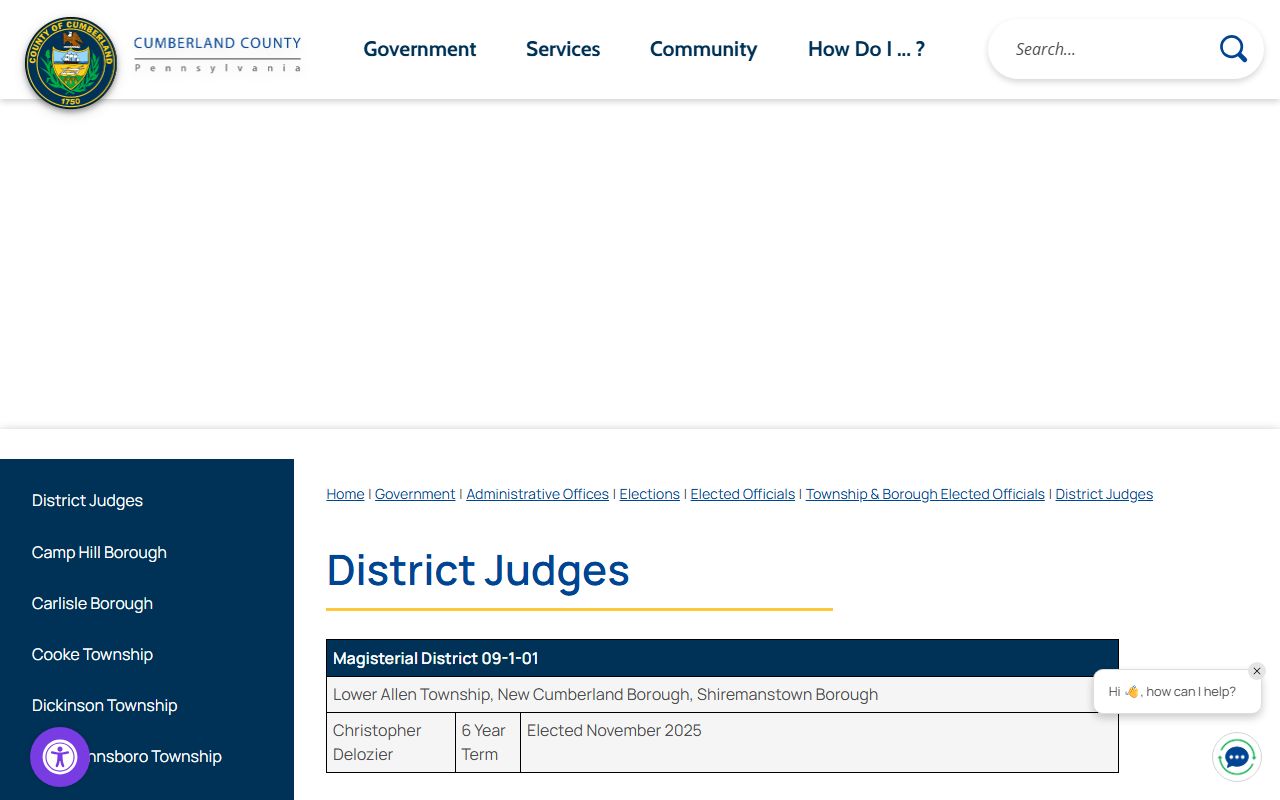
The county lists its district judges and their terms online. See the Cumberland County district judges page.
That mix of seven Common Pleas judges and ten district judges shapes where every case begins and ends. A speeding ticket and a felony both start at the local level, but only one of them stays there.
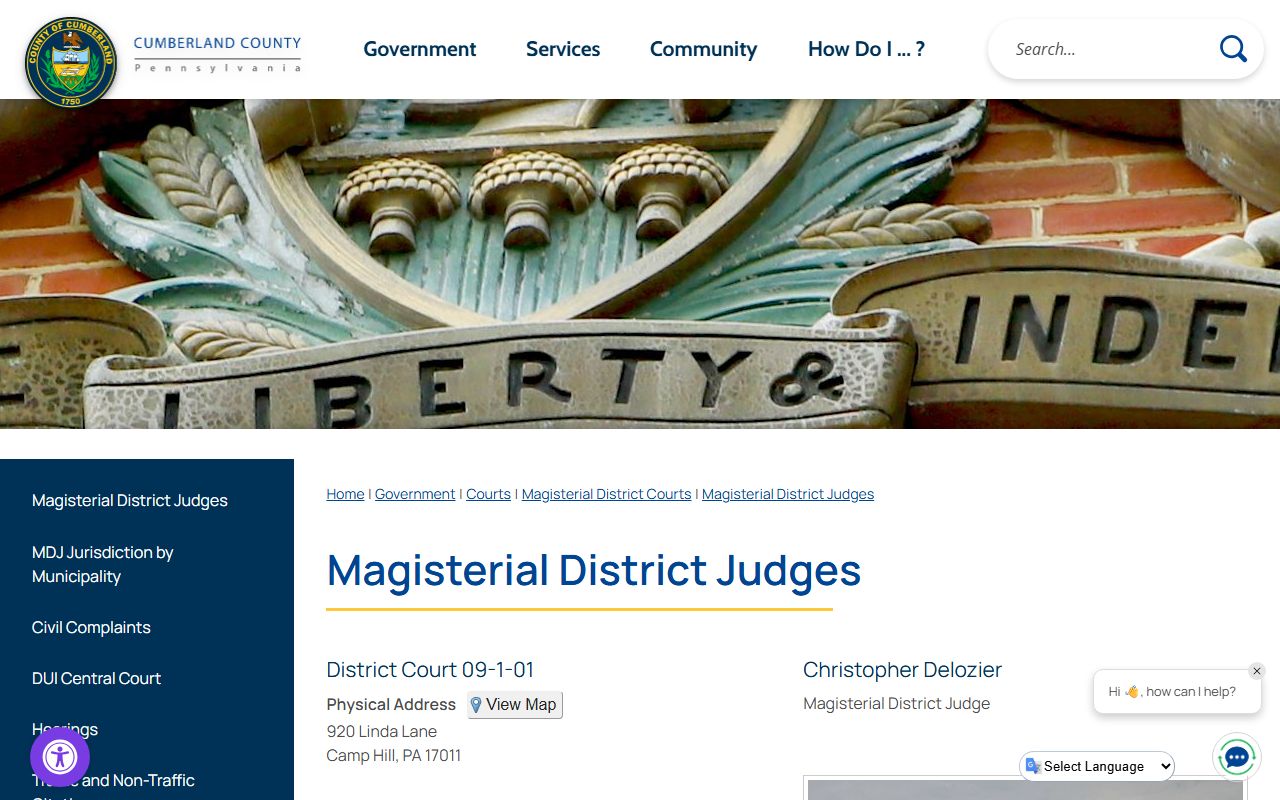
Cumberland County Magisterial District Courts
Ten Magisterial District Court offices serve the county, each covering specific townships and boroughs. They handle traffic citations, summary offenses, landlord-tenant disputes, small civil claims, and the preliminary stages of criminal cases. The table lists each office, the district judge, the address, and the phone.
| District | Judge | Address | Phone |
|---|---|---|---|
| 09-1-01 | Christopher Delozier | 920 Linda Lane, Camp Hill, PA 17011 | 717.737.3434 |
| 09-1-02 | Elizabeth S. Beckley, Esq. | 600 N 12th St, Ste 200, Lemoyne, PA 17043 | 717.761.0583 |
| 09-1-03 | Michael Sanderson | 98 S. Enola Drive, Suite 1, Enola, PA 17025 | 717.728.2805 |
| 09-2-01 | David J. Rogers | 2260 Spring Rd., Suite 3, Carlisle, PA 17013 | 717.218.5250 |
| 09-2-02 | Jonathan Birbeck, Esq. | 20 North Hanover Street, Suite 106, Carlisle, PA 17013 | 717.240.6564 |
| 09-3-01 | Bryan L. Ruth | 35 W. Orange Street, Shippensburg, PA 17257 | 717.532.7676 |
| 09-3-02 | John J. Hanner II | 55 Penn Drive, Newville, PA 17241 | 717.776.3187 |
| 09-3-03 | Daniel J. Freedman | 417 Village Drive, Suite 7, Carlisle, PA 17013 | 717.218.2365 |
| 09-3-04 | Christine L. Line | 5275 E. Trindle Road, Suite 110, Mechanicsburg, PA 17050 | 717.697.2201 |
| 09-3-05 | Mark W. Martin | 507 North York Street, Mechanicsburg, PA 17055 | 717.766.4575 |
The county keeps the office list with coverage areas and hours. See the Magisterial District Judges page.
Common Pleas vs. Magisterial District Court
The two trial levels handle very different matters. Common Pleas is the court of record for serious cases, while the Magisterial District Courts deal with local, lower-level matters and the early stages of criminal cases. The county also runs a Central Court process for DUI cases at the magisterial level. The table compares the levels.
| Court of Common Pleas | Magisterial District Court | Central Court | |
|---|---|---|---|
| Level | General trial court, District 09 | Local minor court | Magisterial-level process |
| Case Types | Serious crime, major civil, family, juvenile, Orphans' Court | Traffic, summary, landlord-tenant, small civil, preliminary hearings | DUI case processing |
| Appeals | To Superior or Commonwealth Court | To the Court of Common Pleas | Feeds into Common Pleas |
How a Case Moves Through the Cumberland County System
Most criminal cases start small and rise. An arrest leads to a preliminary arraignment and a preliminary hearing at a Magisterial District Court, where a judge tests probable cause. Cases held for court are bound over to Common Pleas for formal arraignment and trial. Appeals climb to the intermediate appellate courts and, rarely, to the state's highest court.
Criminal flow: Arrest › Magisterial District Court hearing › Bound over › Common Pleas arraignment › Trial › Sentencing › Superior or Commonwealth Court appeal
Civil flow: Complaint filed with the Prothonotary › Answer › Discovery › Pretrial › Trial › Judgment › Appeal
Civil, Family, and Criminal Divisions
The Court of Common Pleas works in divisions. The Civil Division handles lawsuits, judgments, and liens, with files kept by the Prothonotary. The Criminal Division handles felony and major criminal cases, with files kept by the Clerk of Courts. Family matters, including divorce, custody, and support, run through the civil and family side of the court.
Each division ties to a different records office, which is why the same courthouse has several record counters. For civil files you go to the Prothonotary, for criminal files to the Clerk of Courts, and for estates and Orphans' Court matters to the Register of Wills.
The county also publishes a Language Access Plan and names a coordinator for interpreter and accessibility help, reached at languageaccess@cumberlandcountypa.gov or 717.240.7317. Court Administration oversees court operations across the divisions, from scheduling to jury management, and works from Room 301 at the courthouse. Knowing which division and office handles your matter is the fastest way to the right counter.
Judicial District 09
Cumberland County is its own judicial district, District 09. The Court of Common Pleas there is led by a President Judge, with seven judges total carrying the felony, civil, family, and Orphans' Court caseload. Appeals from this district go to the Superior Court for most criminal and civil matters, or the Commonwealth Court for government and regulatory cases, and finally to the Supreme Court of Pennsylvania.
Carlisle, the county seat, anchors the district. It is home to Dickinson College, the Penn State Dickinson School of Law, and the U.S. Army War College, so the local courts serve a mix of longtime residents, students, and military families. That variety shows up in everyday court business, from landlord-tenant cases to traffic citations to civil disputes.
The state courts explain this hierarchy in plain terms. See the Pennsylvania courts learning page, and the county's own courts landing page for the list of court offices.
Magisterial Courts, Central Court, and Payments
The Magisterial District Courts are Pennsylvania's minor courts. Beyond traffic and small civil matters, they hold preliminary arraignments and hearings that decide whether a criminal case advances. The county's Central Court streamlines DUI processing at this level. Many citations and court costs tied to these courts can be paid online.
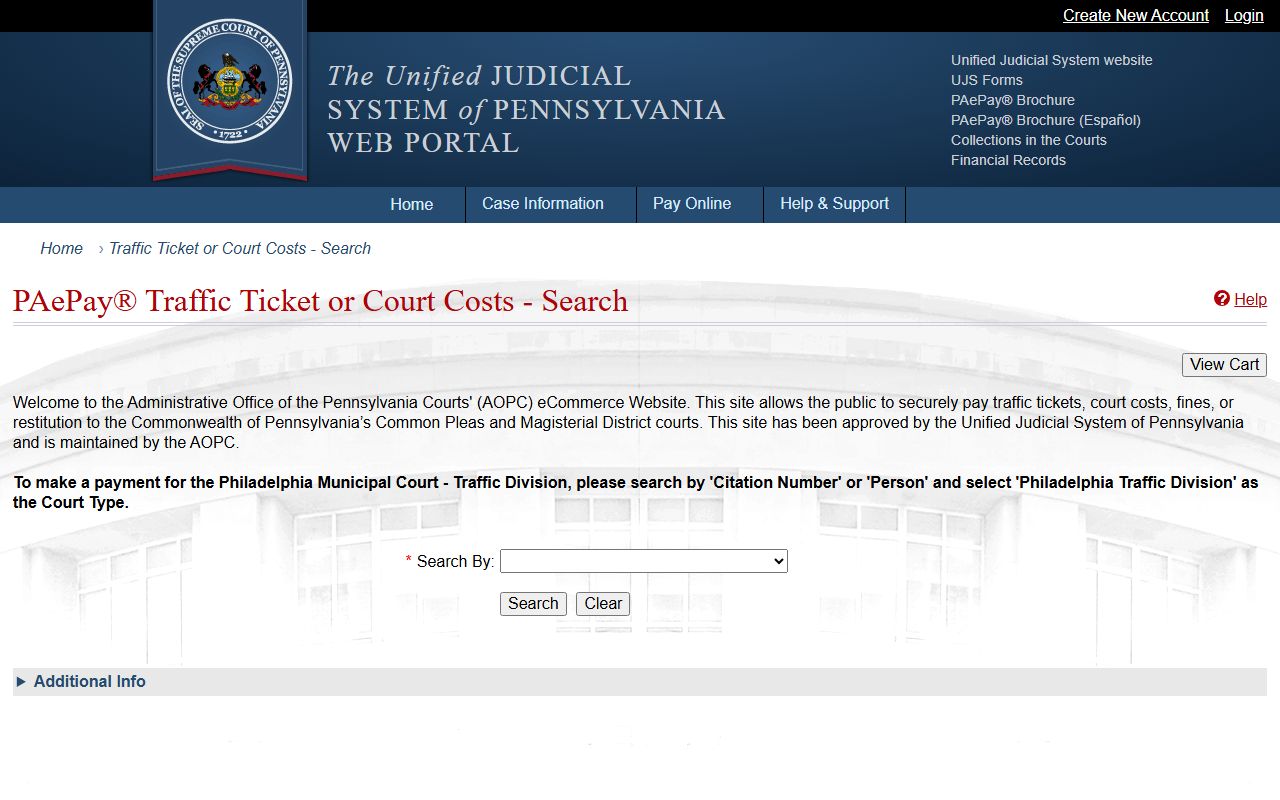
The state runs an online payment portal for traffic tickets and court costs. Use PAePay when a case is eligible and publicly visible.
If a case cannot be paid online, the next step is the district court office named on the citation. Each district office keeps its own hours and coverage area, so check the office that serves the township or borough where the matter arose. A serious criminal charge that begins here does not stay here; once a preliminary hearing finds probable cause, the case is bound over and the record continues at the Common Pleas level under a new docket number.
Treatment and Specialty Courts
The Court of Common Pleas runs treatment courts as an alternative to incarceration for some defendants. As of a July 1, 2025 restructuring, the system is built around Drug Treatment Court and DUI Court, with the former Overdose Intervention Court folded into Drug Treatment Court, plus a TOMS Court for participants with serious mental illness. Applications go to treatmentcourtapplications@cumberlandcountypa.gov.
The county describes its current specialty courts on one page. See the Treatment Courts page.
Drug Treatment Court targets opioid and stimulant use disorders.
It carries a minimum 14-month commitment with therapy, weekly court appearances, and random testing, and Judge Jessica Brewbaker presides. See the Drug Treatment Court page.
The county's treatment-court model dates back nearly two decades.
The Court of Common Pleas instituted a voluntary Adult Treatment Court in 2006, and the Supreme Court of Pennsylvania issued it a Certificate of Accreditation in 2016. The original program ran four phases over about 18 months, with frequent contact with the judge and providers, sanctions for setbacks, and incentives for progress. See the Adult Treatment Court page.