
What Probate Covers in Cumberland County
Probate is the court process for settling a person's estate after death. In Cumberland County, the Register of Wills decides whether a will should be admitted to the record and appoints the personal representative who will handle the estate. The same office processes estate filings and inheritance tax for people who were legally domiciled in the county at death. Lisa M. Grayson, Esq., serves as Register of Wills and Clerk of Orphans' Court.
The Orphans' Court side handles related matters: adoptions, guardianships of minors and incapacitated persons, estate accounts, estate litigation, and termination of parental rights. The Register of Wills page sets out the office's authority and mission.
See the Cumberland County Register of Wills page for the probate authority.
That office is your first stop for opening an estate or probating a will.
Probate Terms Defined
Probate has its own vocabulary, and a few terms come up constantly. Knowing them makes the filings and the fee schedule much easier to read.
- Testator
- The person who made the will.
- Executor
- The person named in a will to settle the estate, who can act only after the Register grants authority.
- Intestate
- Dying without a valid will, in which case state law decides who inherits.
- Letters Testamentary
- The document the Register issues that gives an executor authority to act.
- Short Certificate
- Proof of a representative's authority, issued only after an estate is opened.
- Guardianship
- Court authority over a minor or an incapacitated adult, handled by Orphans' Court.
How to Search Cumberland County Orphans' Court Records
Estate records in Cumberland County reach back to 1750, but only modern records are online. The county offers online access to recent records, with historic files reviewed in the office. A paid online subscription is available by the day, week, month, or year for those who search often.
- Decide whether you need a recent estate or a historic one, since older records are in-office only.
- For modern records, use the county's online estate and marriage records access.
- For historic estates, plan an in-office visit or a written request to the Register.
The online records cover modern estates and marriage records, with the county citing access for recent decades; the exact start year is best confirmed in the portal. Older records, including many estates from earlier generations, are not online and must be pulled in the office. A subscription can pay off for attorneys, title searchers, and genealogists who run frequent lookups, while a one-day pass suits a single search.
Note: a research fee applies when staff search by name, starting with an initial 15-minute charge per name.
Probate Offices in Cumberland County
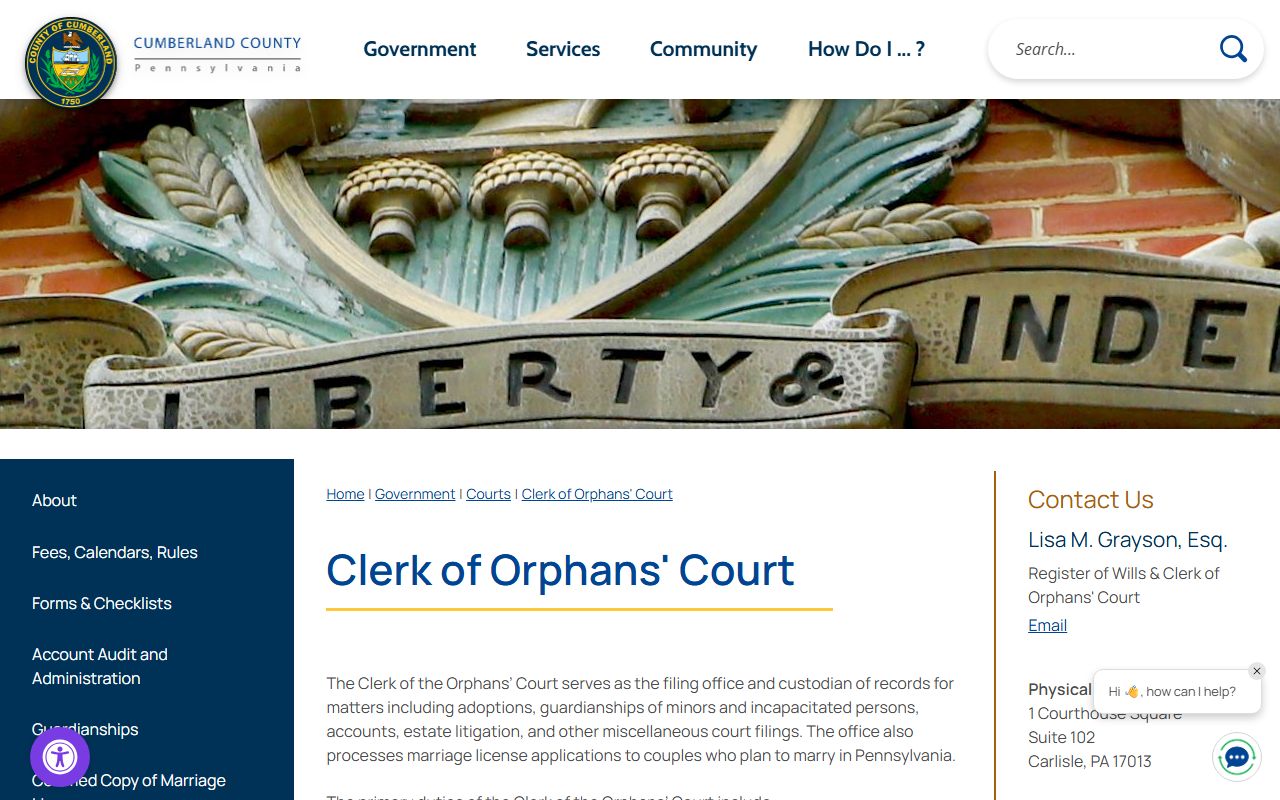
There is one office that wears two hats. As Register of Wills, it admits wills and opens estates. As Clerk of Orphans' Court, it keeps the court files for guardianships, adoptions, and estate litigation. Both functions share Suite 102 at the courthouse.
The Clerk of Orphans' Court page explains its filing role and record coverage. See the Clerk of Orphans' Court page.
Register of Wills & Clerk of Orphans' Court
1 Courthouse Square, Suite 102
Carlisle, PA 17013
717.240.6345
Mon-Fri 8:00 a.m.-4:30 p.m.
Documents Needed to Probate a Will
The Register will not open an estate without the right paperwork, so gather it before you go. The county FAQ lists what the office expects, and missing items mean a second trip. A named executor cannot act until the Register grants authority.
- A completed petition for probate and grant of letters.
- The original will and any codicils.
- A death certificate.
- Executors with valid photo identification.
- Witnesses with photo ID if the will is not self-proven, or a certified translation for a foreign-language will.
Payment is also required, based on the estate value, and wills are generally probated only in the county where the person was domiciled at death.
Steps to Open an Estate
Opening an estate follows a clear order, and the Register's office guides each step. The process below moves from confirming the right county to wrapping up the estate's filings. Take it in order, because a later step depends on the one before it.
- Confirm Cumberland County was the decedent's legal domicile at death.
- Gather the original will and codicils, the death certificate, executor ID, witnesses if needed, and payment.
- Complete the Petition for Probate and Grant of Letters.
- Present the documents to the Register of Wills in person.
- Pay the probate fees, which are based on the gross estate value.
- Obtain the Letters and any short certificates you need.
- File the inventory, the inheritance tax return, and the required estate documents.
For disputes, accounts, guardianships, or estate litigation, the matter moves to the Orphans' Court side of the office.
Probate Filing Fees
The Register charges set fees for filings and copies, and the probate letters fee rises with the estate's value. The figures below come from the county fee schedule. Underestimates of estate value are adjusted, and overestimates are not refunded under the schedule notes.
| Item | Amount |
|---|---|
| Petition | $50 |
| Short certificate | $10 |
| Inheritance tax return | $20 |
| Certified copy, up to 10 pages | $10, plus $0.50 each additional page |
| Probate letters, estate not over $2,000 | $20 |
| Probate letters, estate $75,001 to $100,000 | $210 |
Each additional $100,000 of estate value, or fraction of it, adds $50 to the letters fee.
Common Probate Questions
A few questions come up so often that the county answers them directly in its FAQ. Two stand out for first-time executors and families.
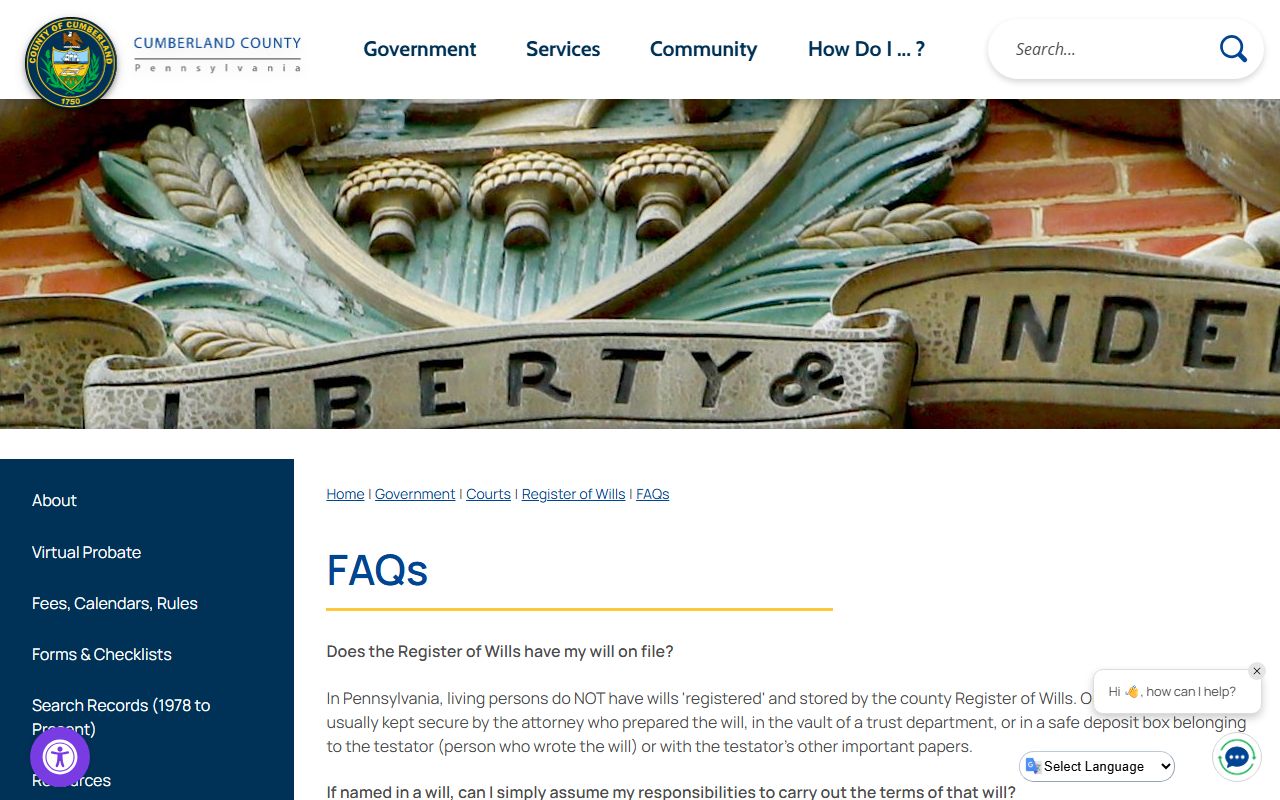
Does the county store my will before I die? No. The Register says living people do not register or store wills with the county. Original wills are usually held by the drafting attorney, a trust department, a safe deposit box, or with the person's papers.
Can the named executor just take over? No. Authority comes from the Register through Letters Testamentary after the will is probated, and a short certificate is issued only after the estate is formally opened.
The county answers more probate questions online. See the Register of Wills FAQ page.
What Cumberland County Probate Records Show
An estate file builds over the life of the case. Early on it shows the decedent's name, the date of death, the petition for probate, and the personal representative. As the estate proceeds, it adds the will or codicils, the letters issued, the inventory, the inheritance tax return, and any accounts or receipts. Orphans' Court files may add petitions, citations, and orders where there is a dispute, a guardianship, or an adoption, though access to some of those is limited.
The county's historical reach is unusual. Estate records run from 1750 forward, and the office also holds older inheritance tax dockets and early birth and death records from the late 1800s and early 1900s. Genealogists and title researchers often use these files, but the oldest material is reviewed in the office rather than online.
Restricted Probate and Orphans' Court Records
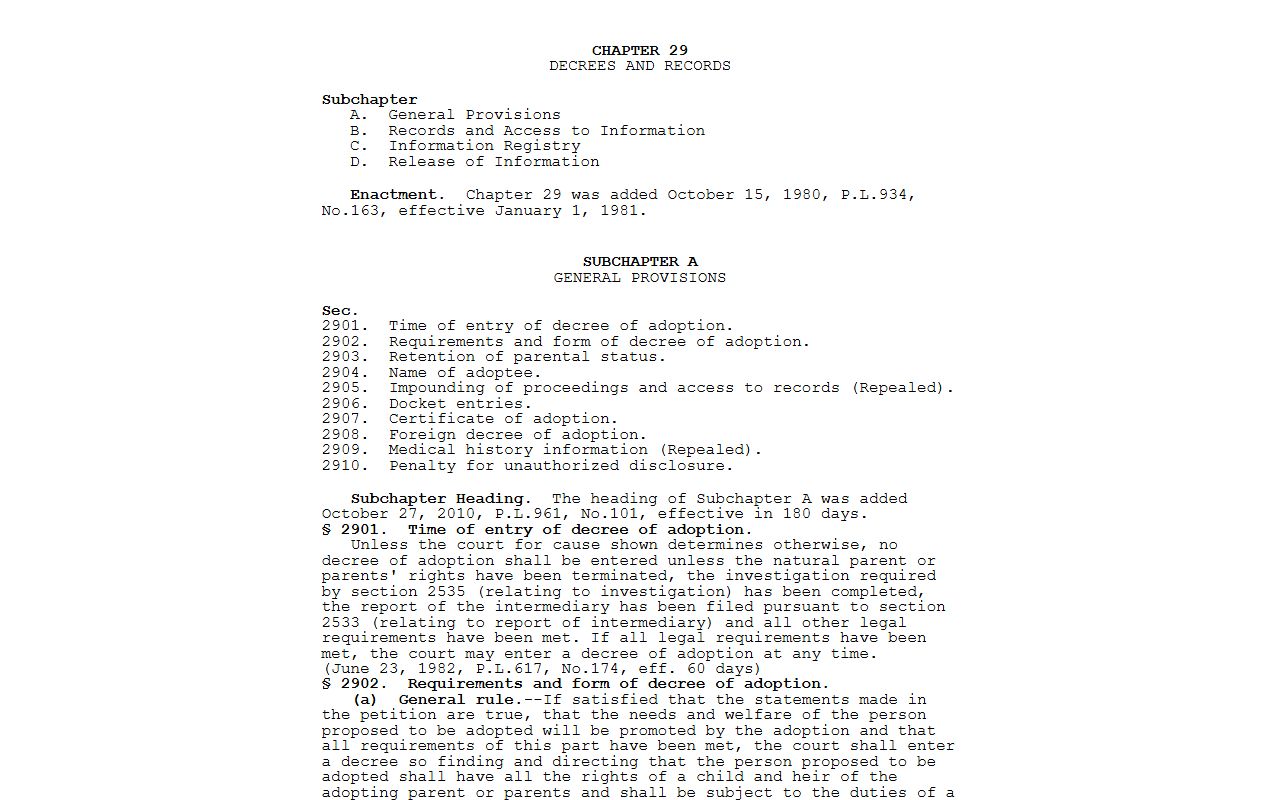
Not all Orphans' Court files are open. The county states that adoptions and guardianships can be accessed in person only by certain parties. Adoption records in particular are treated as permanent records that are withheld from inspection except as the law allows, which is why they cannot be handled like an ordinary estate file.
Pennsylvania adoption law sets these access rules. The provisions are in 23 Pa.C.S. Chapter 29.
If you are a party to a restricted matter, ask the Clerk of Orphans' Court what you may lawfully access. Guardianship files of minors and incapacitated adults carry similar limits, so the office, not an online search, is the right place to start.