
Arrest Records in Cumberland County
An arrest record documents that a person was taken into custody. In Cumberland County, an arrest usually leads to processing at Central Booking and intake at Cumberland County Prison. The Sheriff's Office and local police make arrests; the prison records custody; the courts handle the case that follows. There is no single public "arrest log" on the county site, so the practical record of an arrest is the jail roster plus the criminal docket once charges are filed.
Keep the pieces straight. An arrest record reflects a booking. A criminal court record reflects the case after charges are filed with the Clerk of Courts. A conviction record reflects the outcome. This page leads with arrests and custody; full case history and dockets sit on the Cumberland County court records page.
How to Search Cumberland County Arrest Records
There are two reliable starting points. The county prison posts a current inmate listing that confirms who is in custody right now. Pennsylvania's UJS Case Search shows the criminal case once charges are filed, including the charges, the arresting agency, and the court events. The county's Criminal Justice Services office manages drug testing and treatment-court intake tied to many of these cases.
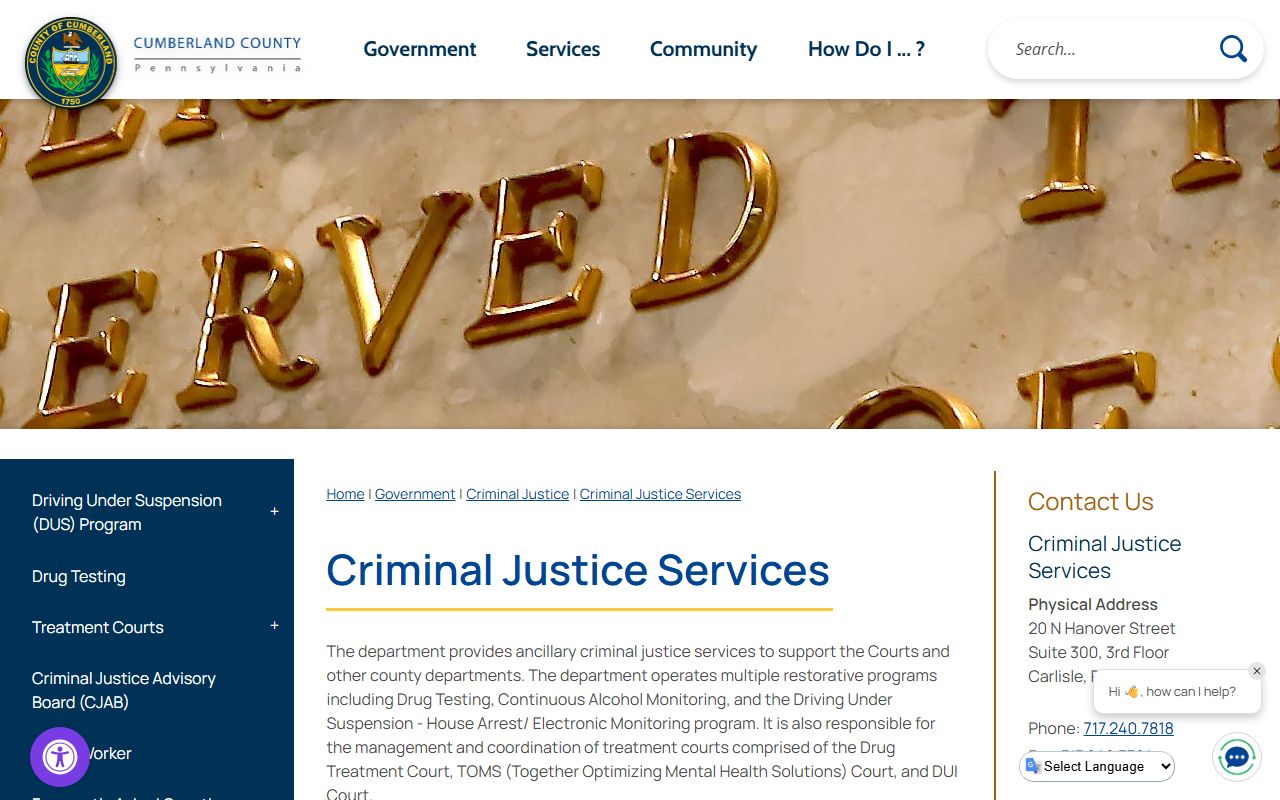
The county explains its criminal justice functions in one place. See Cumberland County Criminal Justice Services for the office and its programs.
Use these steps to move from an arrest to the case file.
- Check the county inmate listing to confirm current custody by name.
- Call Central Booking at 717.245.8792 for booking questions the public list does not answer.
- Search the Pennsylvania UJS Case Search by name or OTN to find the criminal docket.
- Open the docket to read the charges, arresting agency, bail, and court dates.
For a certified criminal history, the docket is not enough. That report comes from the Pennsylvania State Police, not from a court docket.
Booking and the Criminal Process
An arrest is the first step in a longer process, and each step adds to the record. After an arrest, an adult case usually moves through a preliminary arraignment, a preliminary hearing, and then a formal arraignment. The preliminary hearing happens at the Magisterial District Court level, where a judge decides whether there is enough evidence to send the case forward. Most cases that clear that step are bound over to the Court of Common Pleas.
Formal arraignment is the first appearance at the Carlisle courthouse. The defendant is told the charges, advised of rights, and given motion and plea deadlines, after which discovery begins. The county Public Defender represents financially eligible defendants from the first hearing forward. The county criminal process page walks through these stages in order.
Each stage leaves a docket entry, so the criminal record grows as the case proceeds.
Arrest Records vs. Criminal Court Records
An arrest and a court case are two different records, created at different times by different offices. The arrest record begins at booking. The court record begins when a prosecutor files charges. One can exist without much of the other, especially early in a case.
| Arrest Record | Criminal Court Record | |
|---|---|---|
| Source | Sheriff, police, county prison | Clerk of Courts |
| Created When | Booking and intake | Charges filed in court |
| Contents | Custody status, booking info | Charges, pleas, motions, disposition |
Charges vs. Convictions
This distinction matters more than any other. A charge is an accusation. A conviction is a result reached by a plea or a verdict. A docket can list serious charges that were later dismissed, withdrawn, or reduced. Reading charges as guilt is both unfair and inaccurate.
| Charge | Conviction | |
|---|---|---|
| Stage | Accusation | Verdict or guilty plea |
| Burden of Proof | Probable cause | Beyond a reasonable doubt |
| Public Record | Yes, unless restricted | Yes, unless expunged or sealed |
Sealed vs. Expunged Records in Cumberland County
Pennsylvania treats sealing and expungement as two different things. Expungement removes qualifying criminal history record information under set conditions. Limited access, sometimes called sealing or Clean Slate, shields qualifying records from public view without destroying every government copy. A limited-access record may still reach criminal justice agencies. The Clerk of Courts lists a petition to expunge or limited access as a fee item, currently $155 with possible added fees.
The expungement rules sit in the state crimes code. The full text is in 18 Pa.C.S. § 9122, with juvenile expungement under section 9123.
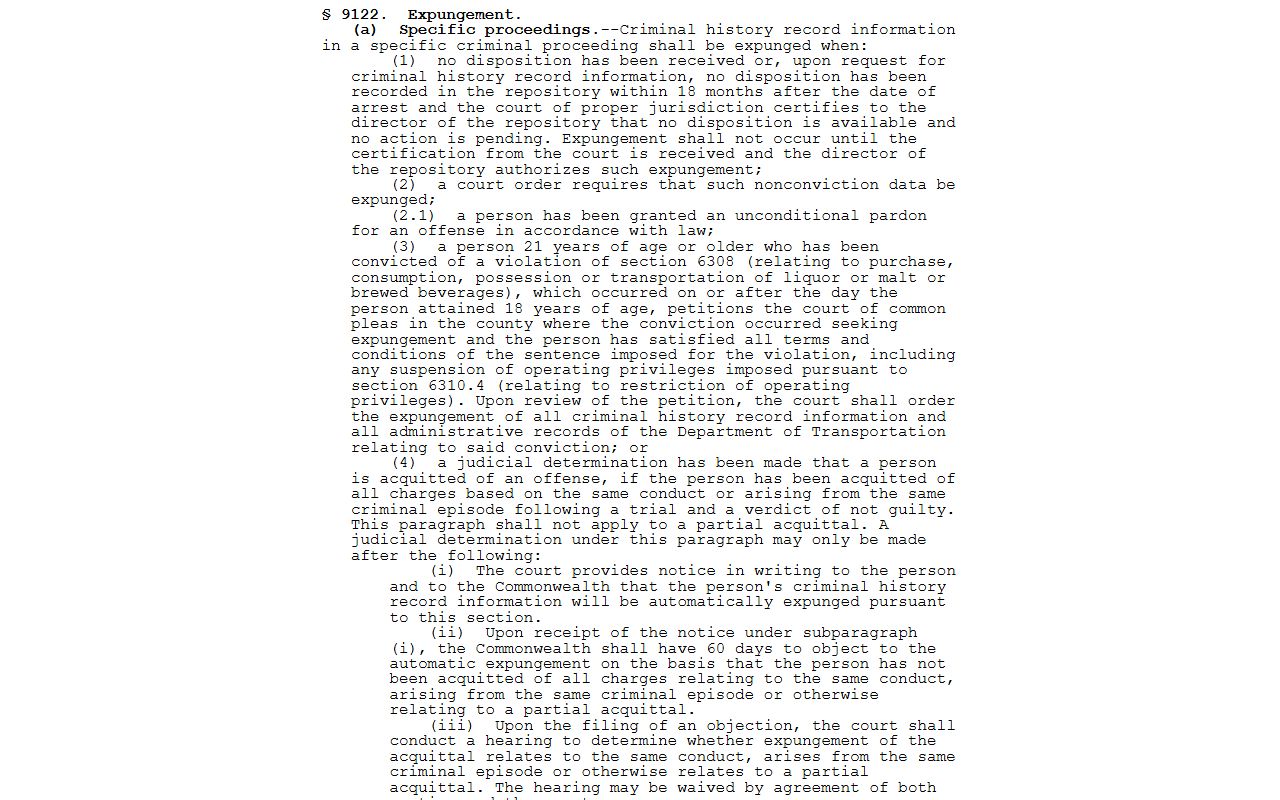
Because of these rules, the UJS portal will not display expunged or limited-access cases even with a correct name.
| Sealed / Limited Access | Expunged | |
|---|---|---|
| Visibility | Hidden from public view | Removed; treated as if it did not exist |
| Law Enforcement | May still have access | Very limited access |
| Eligibility | Clean Slate and qualifying records under Act 5 of 2016 | Narrow grounds under 18 Pa.C.S. § 9122 |
The Cumberland County District Attorney
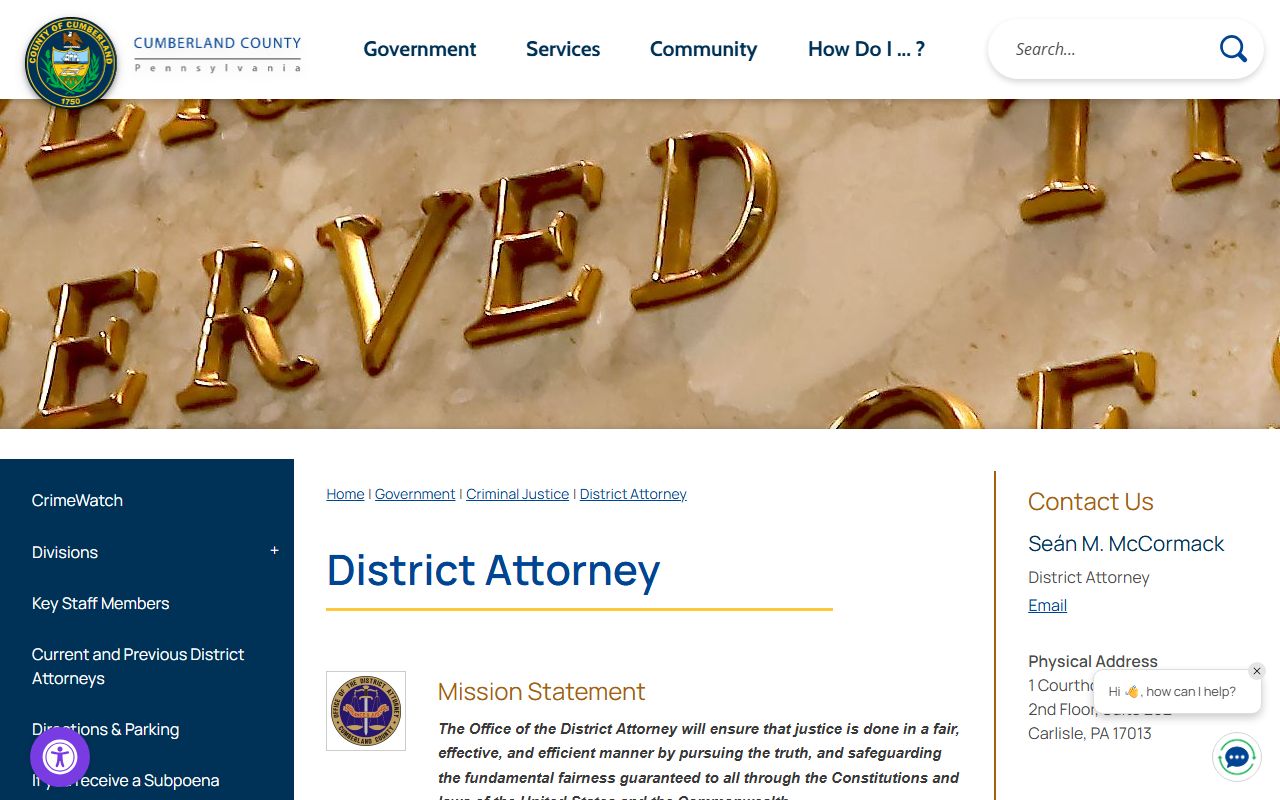
The District Attorney prosecutes crime in the county. The office is led by District Attorney Seán M. McCormack and sits at 1 Courthouse Square, 2nd Floor, Suite 202, in Carlisle, phone 717.240.6210. Its stated mission is to pursue truth and safeguard fairness while asserting victims' rights and protecting the rights of the accused. One feature sets the office apart: it runs its own forensic laboratory for crime scene processing, fingerprint analysis, DNA, digital imagery, drug testing, blood alcohol testing, and computer forensics.
The office publishes its mission and lab detail online. See the Cumberland County District Attorney page.
That in-house lab is why some criminal case files reference forensic reports or digital evidence in their docket entries.
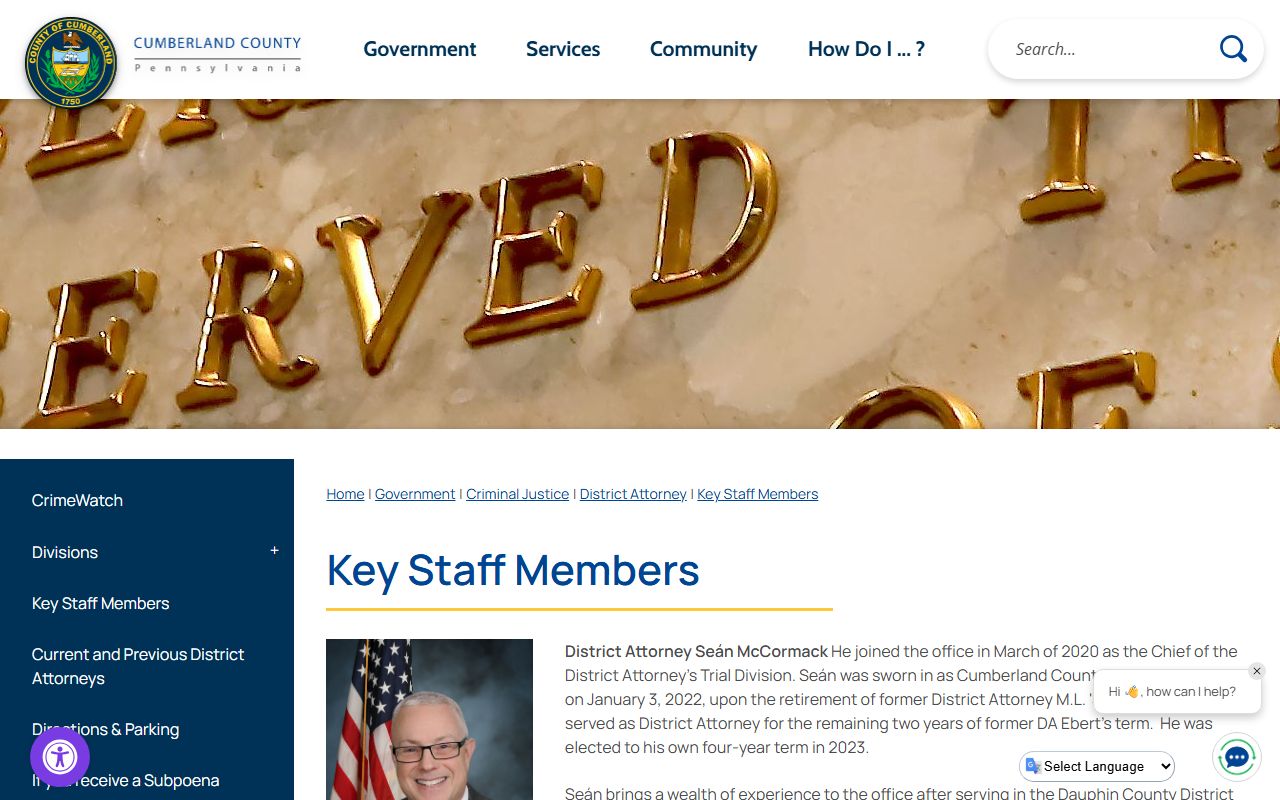
The DA also names its leadership. Daniel J. Sodus serves as Chief Deputy District Attorney and Chief of Specialty Courts, and Julia Skinner serves as Chief of the Trial Division. The Key Staff Members page lists the office leadership.
Victim Services within the office assists witnesses and crime victims at 717.240.6220.
Prosecution Continuity in Cumberland County
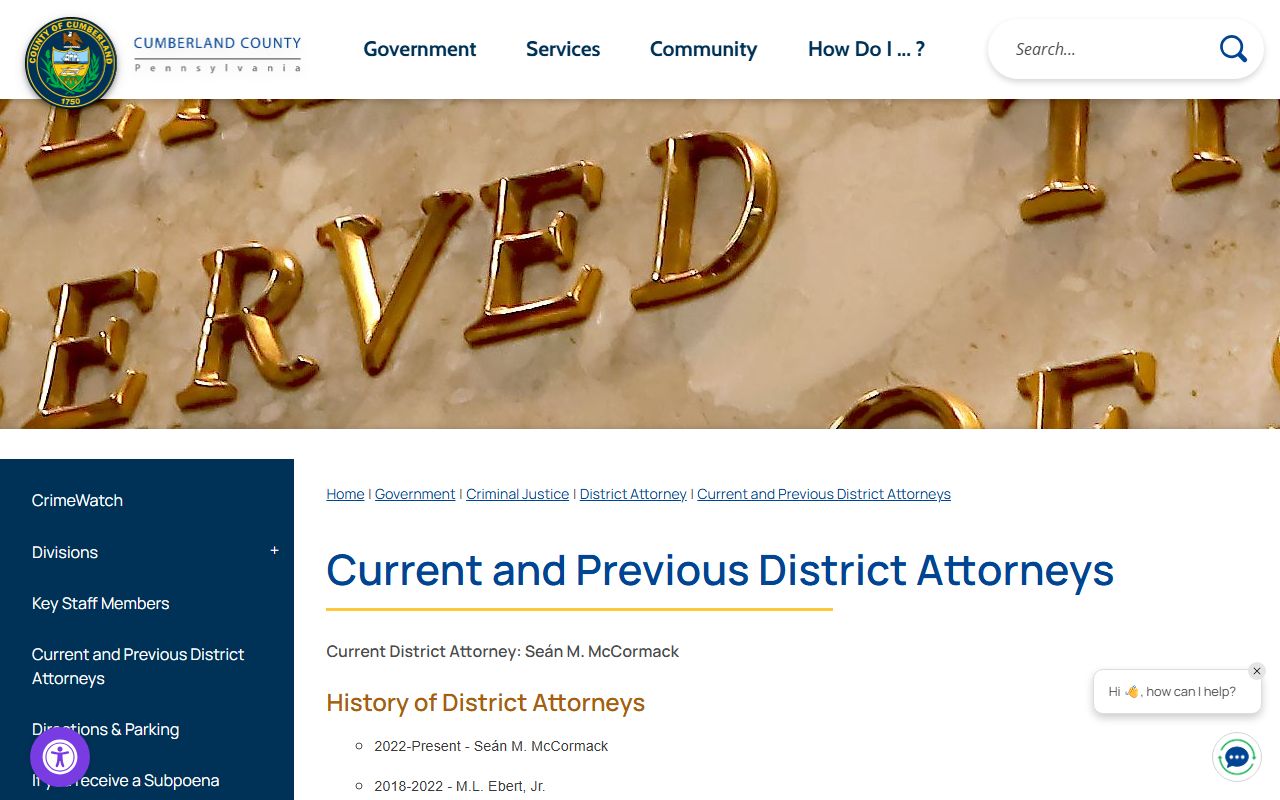
The county documents a long line of prosecutors. District Attorney McCormack was sworn in on January 3, 2022 and elected to a four-year term in 2023. The county publishes a lineage of past district attorneys reaching back to William H. Miller in 1850. That continuity matters for records research, because older cases are tied to the office structure of their time.
The full list is posted by the county. See Current and Previous District Attorneys.
Today the case path runs from arrest, to preliminary hearing in a Magisterial District Court, to formal arraignment at the Carlisle courthouse.
Mugshots and Booking Photos
People often expect a mugshot with an arrest record. Cumberland County does not provide one in its public tools. The official inmate listing shows only names, the current total population, and a timestamp. It does not include booking photos, charges, bond, or arrest dates. For booking detail beyond the public list, contact Inmate Records at 717.960.5528 or Central Booking. Be cautious with private mugshot sites; they are not official and may be inaccurate or outdated.
Background Check Considerations
A casual name search is not a background check. The UJS docket sheet warns that it should not be used in place of a criminal history check, which the Pennsylvania State Police provide. Employers, landlords, and licensing bodies that rely on criminal history must follow the Fair Credit Reporting Act and Pennsylvania rules on the use of records. A dismissed charge, an expunged case, or a limited-access record should not be treated as a conviction.
Important: This site is not a consumer reporting agency under the FCRA, and its information may not be used for employment, tenant, credit, or insurance decisions.
Restricted Criminal Records in Cumberland County
Some criminal records are not public. Juvenile cases are kept out of public view, and the UJS portal may not display them at all. Expunged and limited-access cases drop off the public dockets. Sealed search warrants and grand jury materials are not ordinary public records. Mental health commitment material is confidential by statute. If a case you expect to find does not appear, one of these limits, or a simple update lag, is usually the reason.
Note: A missing case is not proof of innocence or guilt; it may be juvenile, expunged, limited access, sealed, or simply not yet posted online.